If an AI assistant describes your hotel incorrectly, start with the disputed statement, not with another batch of promotional copy. Record the answer and its context, confirm the actual fact with the property team, inspect relevant public sources and assign each correction to someone who can make it. Then check what changed. A website edit is something you can verify; a future AI recommendation is a separate observation.
A guest who expects a pool in February will not be comforted by an impressive visibility score. Accuracy belongs in the commercial brief because it affects the fit between the stay someone imagines and the stay you can actually provide. This guide turns that brief into a small, maintainable correction programme.
1. Save the claim before changing anything
Copy the question and answer, note the date, language, location context and platform, and save a screenshot. Record any visible source links and whether the interface used a search or browsing mode. Separate what the answer actually says from what your team thinks caused it.
“The assistant says we have free parking” is a usable observation. “The assistant copied an old directory” is still a hypothesis until you inspect the relevant evidence. Even a cited page may support only part of the answer. Keep the exact disputed sentence alongside each source rather than treating the whole response as one error.
Do not put guest details or reservation records into test questions. A neutral property-and-policy question is enough to investigate most public information problems.
2. Find the person who can confirm the fact
Marketing can publish the correction, but it may not own the answer. Front office may confirm arrival arrangements, operations may own pool opening dates, reservations may confirm room occupancy, and the appropriate property specialist should review detailed access information. Assign an owner for the particular statement.
Ask for approved wording, effective dates, exceptions and a review trigger. “We accept pets” is incomplete if the policy applies only to certain rooms or requires advance confirmation. The public wording should describe the actual condition, with an appropriate contact route for individual needs.
Where the team cannot yet confirm a fact, mark it unresolved. Replacing an uncertain answer with a confident but unsupported sentence creates a second problem.
3. Rank errors by the decision they could distort
Not every discrepancy deserves the same response. Prioritise a false closure, wrong property identity, material booking condition or incorrect facility claim ahead of a harmless variation in a descriptive adjective. Consider the affected guest decision and the risk of disappointed expectations.
Use the following as a fictional working example, not an audit of a real hotel. The final column is a proposed action; it does not mean any external answer or listing has already been corrected.
| Observed statement | Confirmation needed | First owned action |
|---|---|---|
| The pool opens all year | Operations confirms the season and any temporary exceptions. | Publish the approved opening conditions on the pool page and review linked summaries. |
| Parking is free for every guest | The responsible team confirms charges, capacity and reservation conditions. | Replace the ambiguous parking sentence and identify external listings needing review. |
| Every room sleeps four | Reservations confirms occupancy by actual room category. | Correct the category pages and compare their wording with the booking journey. |
| The hotel has permanently closed | The owner confirms current trading status and any earlier name or closure period. | Make the property identity and current status clear, then request corrections from relevant profile owners. |
A fictional first release: the “free parking” problem
Imagine a hotel whose reservations team receives a recurring question: “Why is parking being charged when the description says it is free?” In this invented example, the current policy requires a separate reservation and a charge. Operations approves that wording. The marketing team finds an old offer page saying “free parking” without explaining that the offer has ended.
The first release is deliberately small. The content owner updates the current parking page and the old offer’s status, checks the room summaries that mention parking and gives the translated wording to the language reviewers. The distribution owner reviews the corresponding descriptions on the channels they manage. The implementation owner checks that the website links still take a mobile reader to the intended information.
The delivery record contains the approved policy, the affected URLs, publication dates, external correction requests and unresolved items. It can also contain before-and-after answers from a documented question set. It does not claim that the old offer caused every incorrect answer, that an external platform accepted a correction, or that a booking was recovered.
This is a planning example, not work carried out for a client. Its value is the division of responsibilities: operational truth, editorial wording, distribution changes and publication verification. A hotel can use the same structure for a different disputed fact without launching a complete website redesign.
4. Inspect the source landscape without inventing a chain of causation
Start with the pages the answer links to, if any. Then examine the relevant official page, language versions, booking journey, business profiles and distribution listings. Look for old names, property mix-ups, undated PDFs, obsolete offers and descriptions copied between categories.
A mismatch is evidence of a public information problem. It is not proof that the mismatch caused a particular model output. Keep those findings separate in the report. This prevents the work turning into an endless hunt for a single page that may never have been the sole source.
For a hotel group, use property identifiers and addresses in the register. A rooftop belonging to one hotel should not drift into the description of every property carrying the same brand.
5. Correct a useful page, not just a sentence in the footer
Put the approved information where a guest would reasonably look for it. Pool conditions belong on the pool or facilities page, room occupancy belongs with the relevant room category, and parking arrangements need an accessible practical-information route. Keep the wording understandable without requiring the reader to infer conditions from a photograph.
Review the obvious summaries too: room cards, offers, FAQs and downloadable brochures. A correct detail page can coexist with an old claim in a prominent summary. Record which locations were checked rather than declaring the entire website consistent after one edit.
Google’s guidance for AI features in Search says ordinary SEO fundamentals remain relevant: useful textual information, discoverable pages and structured data consistent with visible content. It does not specify a special AI markup that guarantees inclusion. Treat technical eligibility and the accuracy of an observed answer as different questions.
6. Make room information comparable
Noor Zhou’s Hotel Website UI UX Design is a personal design project. Its booking-list screen makes room categories, occupancy, bed information and the selection step visible together. That is a useful interface reference when deciding where approved room facts should appear.
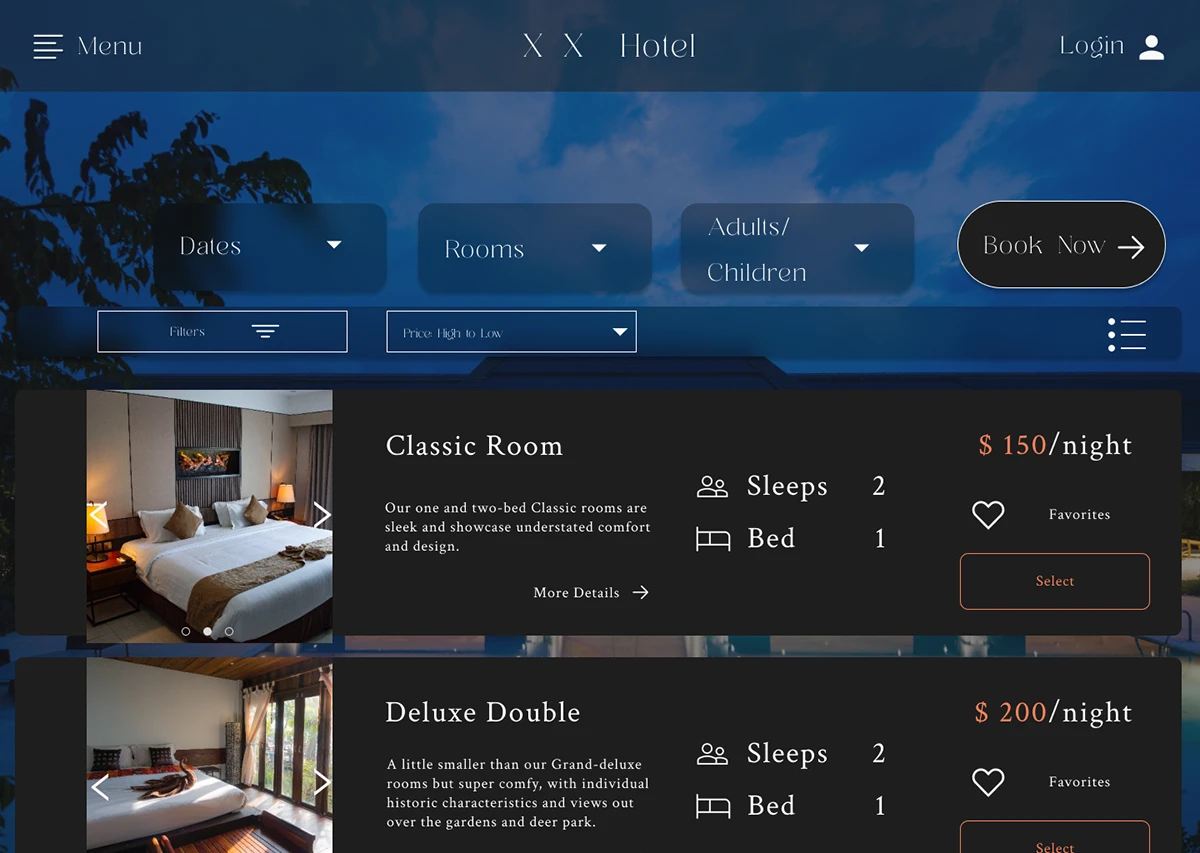
The reference is about information placement. Its example room names, prices and claims are not facts to borrow for your hotel. A polished card still needs an approved data owner; design and information maintenance must meet at that point.
7. Give external corrections their own owner
List the profile, distribution partner or publisher, the disputed wording, the requested replacement and the person authorised to contact it. Keep a record of the request and the eventual public result. Sending an email or opening a support ticket is not the same as a corrected listing.
Some sources are outside the hotel’s control. An old editorial review may remain a historical account rather than become current policy. In that case, strengthen the current official information and distinguish the historical context instead of pretending every reference can be rewritten.
Do not manufacture reviews or ask guests to repeat a prescribed “AI-friendly” phrase. The programme should improve the evidence available about the property, not create artificial corroboration.
8. Treat languages as linked records, not interchangeable strings
A corrected English room description does not fix a contradictory Spanish page. Map each affected fact to its actual language equivalents and assign a reviewer who understands the policy. Maintain the factual condition while adapting the wording to the traveller’s question.
Be especially careful with occupancy, units, opening periods and “included” versus “available for a charge”. These small phrases can change the offer someone believes they are booking. If a language version is missing, record that gap; do not create a link that sends the reader to an unrelated article merely to fill a language menu.
The wider GEO for hotels guide connects this information work with destination content, room pages and the booking journey.
9. Verify the publication before re-running the question set
First check the work you control: the intended page shows the approved wording, the mobile version is readable, linked documents are the intended versions and translated routes resolve correctly. Confirm any relevant website implementation with the team responsible for it.
Then repeat a small, recorded question set. Keep the wording, language and context documented, and save the resulting answers and visible sources. Label a changed answer as an observation at that time. One correct response does not establish that all future answers, languages or interfaces will be correct.
If the answer stays wrong, review the remaining information conflicts and the evidence available. Do not keep republishing the same paragraph every day or report a promised correction deadline that no external platform has committed to.
10. Separate completion from commercial outcomes
The delivery register can track facts approved, owned pages corrected, external requests resolved and checks completed. Those are useful measures of the work. Search visits, qualified enquiries and booking progression belong in a separate outcome view with their own evidence.
Record the measurement boundary. A guest can read several sources before booking, and a changed answer may never produce an identifiable website session. Do not assign a booking to this programme merely because the dates overlap.
For a repeatable observation method, use the LLM visibility audit guide. Accuracy should be one dimension of the review, alongside relevant presence and the sources actually observed.
What to commission first
Start with one property, one priority market and a short list of facts that could materially change a guest decision. A useful first engagement delivers an approved fact register, a map of affected pages and external owners, the agreed website corrections, publication checks and a dated answer-observation record.
Agree who supplies operational truth, who approves wording, who can change the CMS and distribution profiles, and which work is excluded. Booking-engine development, live inventory integration and a group-wide rollout need explicit scope where required. The audit is not a promise of control over an AI platform.
The hotel GEO agency programme describes the commercial route. Discuss a hotel information correction brief with one disputed statement, the relevant property URL and the people who can confirm the facts. That is a better starting point than buying another hundred destination pages.